By: Mingcao, Valerie and Thomas
Michael Moore and Rhetoric
In this week’s Documenting Myths class, we watched two documentaries made by Michael Moore; Fahrenheit 9/11 and Capitalism: A Love Story. We also learned about Greek mythology and manipulation through rhetoric (pathos, ethos and logos) to help us with the following assignment. Pathos is a Greek word that defines “emotion”, ethos is “credibility” or “ethical appeal” and logos means “logic”. With this knowledge we could have a better understanding of Moore’s goals and strategies throughout these films and could make connections with the mythology.
Propaganda: Who to Believe?
Fahrenheit 9/11 is a 2004 documentary film of 122 minutes by Michael Moore. It was filmed in the United States, but was only released months after it had been released in other countries because of some legal problems. The movie received much critical acclaim; it received a Palme d’Or at the 2004 Cannes Film Festival and is noted to have received a 20 minute standing ovation. It was also a huge box office success, becoming the second highest grossing documentary. The movie is a reflection and critic on George W. Bush’s presidency from 2000 to 2004, the attacks on the World Trade Center on September 11th 2001 and the War on Terror that Bush declared, from Michael Moore’s point of view.
The main issue presented in the documentary revolves around the manipulation and propaganda employed by the U.S. government under George Bush’s presidency and how it related to the war in Iraq. The film focuses around the tactics used to instill fear in the citizens as a method of propaganda. The population would be on high alert at all times because of news channels and other forms of mass media broadcasting warning messages about possible terrorist threats. Government officials and Bush himself delivered speeches about threats that the nation was supposedly exposed to. The Homeland Security Advisory System would also raise the alert level to red and back to orange or yellow, repeating this back and forth to keep a constant aura of threat to keep the population fearful. Another instance where propaganda was employed was during the recruitment of new troops, especially in less fortunate places like Flint, Michigan, where many of the interviews took place. They proceed by seemingly interrogating their prospective recruits and often promising them things that could fulfill the less fortunate kids’ dreams, which often were not entirely true and were twisted into a different context, that they would get in return for enrolling in the military.

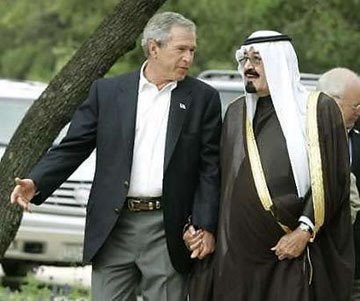
Another major issue presented in the film is Bush’s intention. Over the course of the film, we can see that his motivation may not be for the good of the country, but lies in his self-interest. The relationship between George W. Bush’s family and the royal Saudi family is a primary indicator of that, because the man responsible for the 9/11 attacks was part of Bin Laden family, which was in turn closely connected to the royal family. We are shown the close relationship between these two families; 24 individuals that were part of the Bin Laden family were allowed to leave the country, without any proper interrogation days after the 9/11 attacks. Unsurprisingly, much of the funding and investments in Bush’s oil company were from the royal Saudi family. The Bush administration also created false pretenses under which they invaded Iraq for their large oil supply. He led people to believe that Saddam Hussein was in the process of making nuclear weapons and that to end the terrorist threat that the Taliban were posing, they would have to invade Iraq, a country that had never done a thing to the United States. This motivation driven by self-interest does not only apply to President Bush, towards the end of the film, Michael Moore asked various congressmen with no children enrolled in the military who approved of the war and long term deployment if they would like to enlist their children in the military.The answer was no for all of them. This shows that people in power have an insatiable thirst for power and wealth, ignoring the real reason people elect them in the first place.
The film itself is like a puzzle, Michael Moore gives us various pieces of information, and with all of it assembled together, we can create a relatively clear picture of what he is trying to convey. Moore never forces his views on us, but frequently asks rhetorical questions, which leave us agreeing with him most of the time. This film relates to the topic seen in class this week, rhetoric. Michael Moore employs all three aspects of rhetoric in this film: logos, ethos and pathos. Logos is using facts, statistics and other statements to persuade us. He tells us many facts, such as Bush being on vacation, away from Office, 42% of the time in his first term of presidency, 24 Bin Laden family members leaving the country, etc. Ethos is the use of credentials to get us to believe a point. He conducts many interviews with people of all positions: congressmen, FBI and other security agents, psychologists, soldiers on deployment, and regular citizen, such as Lila Lipscomb, the woman who lost her son while he was on duty. The people working directly in relation to the government or to the war are undeniably deemed credible sources. However, Lila Lipscomb also has credibility, because she is one among the thousands and millions of families who have suffered from the war. Finally, pathos is the usage of emotion as a mean of persuasion whether the emotion conveyed is sadness or happiness. Moore uses footage of Iraqi people and soldiers suffering from the war in an attempt to convince you through sorrow. He also uses montages of videos to make a fool out of George Bush, while also adding comedic sounds or music for comic effect. The combination of logos, ethos, and pathos makes a documentary convincing and persuasive, as shown by Michael Moore’s documentary.
The movie is very well structured, Moore doesn't simply throw the pieces of the puzzle at us, he gives them to us in a chronological order, which follows an order of time and at times, an order of logic. Each piece of information given contributes to his goal. Whether he is showing us video footage of events, interviews with people, or even live footage of himself, we can piece them all together, to get a message. Moore is a master of manipulation, he puts scenes that trigger questions in our heads at the beginning of the film as an attention grabber, he then recounts events in order to let us form a general opinion about the subject in matter continued with examples and details that bring up several emotions to stir our minds up, and finally concludes with a more determinate answer in an indirect way.
However, as convincing as his film may be, we must still remember that even he is biased. While his documentary does provide some good points, we can consider it to also be propaganda. The movie focuses on the idiotic side of President Bush and has no mention of the good things the Bush administration has brought to the United States. Without us realizing, Moore used many propaganda techniques in his movie, which are elaborated upon on this link:
So a lesson learned from viewing this movie is that although something may seem credible and unbiased, there is almost always a matter of personal opinion that comes into play, and in this film, it seems like Michael Moore’s dislike for the former president incompetence may have fueled the essence of this movie, which is to share his point of view and perhaps get the viewers to also build up a dislike for Bush and to not vote for him.
Money over Everything
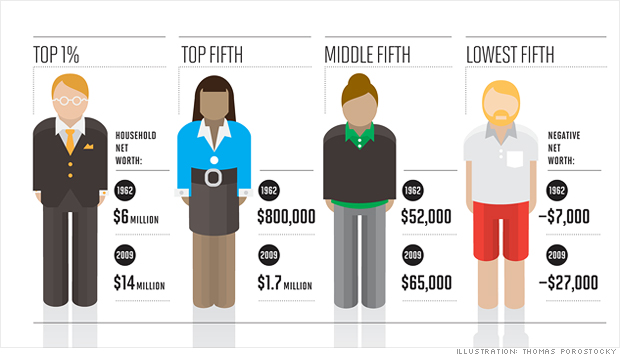
Capitalism: A Love Story is a documentary of 127 minutes by filmmaker Michael Moore, which takes a subjective look at the economical crash in 2008 and how it affected the Americans who lost everything they had and a look at those who profited from it. He started the movie with a home-made video from American citizens getting evicted from their homes by police officers breaking their way in and arresting them. This made us question what happened and Moore shortly began to explain to us what capitalism really is. In his words, capitalism is a concept of taking and giving a fair share of our wealth, but mostly taking, which leads us to something called the profit motive. That means people will do anything to make profits, no matter who suffers the consequences. For example, they made an institution with lucrative intentions for delinquent kids and teens to be placed in for rehabilitation. Judge Ciavarella sentenced children for minor offences in order for his friends, those who run the facility, to make money. One boy that Moore interviewed was sent into Luzerne County Court of Common Pleas for throwing a piece of steak to his mom’s boyfriend. How ridiculous is that? Ciavarella later pleaded guilty to Honest Services Fraud.
Another example of making profit for all the wrong reasons is “the dead peasant policy”. A company who can buy into a life insurance for their employee is called corporate-owned life insurance. Without that employee or their family knowing, their life is covered so when they pass away, that company can collect tax-free death benefits. In other words, you could be working for a company who receives money from your death, and you wouldn't know anything about it… awful isn't it? In case you didn't know, Wal-Mart is one of those companies.
I think what makes the film special is that Moore used real-life stories and real people going through these shocking situations, showing us how they feel. This really plays into the pathos, making us feel pity for those who are victimized and feel anger towards the victimizer.
One of the first cities to be affected by the money-grabbers is Michael Moore’s hometown of Flint, Michigan. General Motors (GM) went bankrupt, leaving thousands of people without jobs, and practically the whole town was left unemployed soon after that. Nowadays, ironically, Flint has a “sign-making” company that provides 60% of foreclosure signs across the U.S, which is the sign they put up in front of a house once the people inside have been evicted. Moore gives us statistics to prove a point, making use of logos. Many of the facts he used are compiled on this link to show his extensive use of logos:

Moore also uses the “ethos” part by showing us interviews with people who we think have credibility, such as Harvard professor Elizabeth Warren. She couldn't even answer Moore’s question of “Where’s our money?” which just goes to show that sure, she has a big name, but does she really know what she’s talking about? Also, Moore enjoys making former President Bush look like an idiot on camera, so it makes us wonder if he really knew what he was doing while he was in office.
After watching Capitalism: A Love Story, we now have a better understanding of what really happened, where it at all started. Americans have been fooled by the “Great concept of Capitalism”. The movie has made us reflect on how cruel and heartless one can be. Some will go to the end of the world to take everyone else’s money and leave them in misery. Maybe these profiteers will watch Moore’s film and understand the damage that has been done to millions of Americans.
Rhetoric in our Lives
Many have felt the tragic attack on the world trade center on September, 11, 2001 and have lost belongings during the 2008 recession. In the movies Fahrenheit 9/11 and Capitalism: A Love Story, directed by Michael Moore, we are sent on an emotional rollercoaster with the interview of people who have lost loved ones to more comedic videos that made Bush look like a fool. Many examples of these emotional spirals in both movies to make us to grasp the situation and what we can learn from them.
People felt fear because of 9/11 and the American economy collapsing on itself and the government used that fear to manipulate the population, so that nobody would question what they were doing. However, fear will only last until the people are raised by courage, courage from the workers at factories for not leaving the building until they were paid the right amount of money, courage that the soldiers who enlist in the military so that we are safe from physical and emotional harm have shown us. "You can't kill someone without killing a little bit of yourself" as one of the soldiers said. When people learn not to fear, they can achieve goals that the government doesn't want them to. This film doesn't just teach us about courage or pain, but to see what the truth is.
Michael Moore is a master of playing with the audience’s emotions, but with each emotion that he makes us feel, we ask can ourselves this question: "Are we being manipulated?" This critical aspect of the film is part of what made it so famous, the self-reflection that made people realize certain truths that were untold. The way that the way that Moore structures his films is Capitalism: A Love Story begins with a shocking scene of police men breaking into a home and arresting the home owners, and then proceeded to explain the situation and the main issue that we will explore throughout the film. Right away he captures your attention with this kind of imagery. He’s very skilled at playing with your emotions and shows you shocking examples to make you think about what kind of world we live in. He can make you feel sad one second, you’re cracking up the next and he leaves you with your jaw dropped to the ground. He also has a great sense of humor which definitely make his films captivating and makes you want to keep watching.
Michael Moore uses many techniques of manipulation to get us to believe his arguments and eventually agree with him. He gives many facts and statistics, but without expressing his real intention. What he gives us is like a puzzle with all the pieces and wants us to assemble it ourselves, making it more convincing for us since it lets us make our own assumptions which we most often times believe. He then uses many heart breaking stories to sadden us in an attempt to make us side with him as if it were in pity or compassion. This usually is a strong factor in his persuasion, as stories of families whose children died on deployment and families that greatly suffered from loss during the recession. It makes us reflect on how it would be if we were the ones in that situation and how we would feel. Our sympathy towards the victims in his documentaries translates to us sympathizing with his argument. He also makes us laugh through many montages of clips of George Bush’s idiocy and simply by poking fun at Bush in general. This makes us think that Moore is a likable person whose arguments won’t simply be brushed off. He also uses many clips of interviews in his documentary, allowing us to see that many people share his opinion and that we should too, because after all, the more the better. All these techniques seemed to work very well, as we agreed with the majority if not all of his arguments and that when we finished watching the two movies, we shared the same opinion as him.

We have already suffered from the Iraq War for a dishonest cause and the results were the deaths of many men and women and wasted time and resources. Obama had made actions that have improved the United States by creating more jobs and trying to implement public health care. It would seem strange for a man that has done so much good to consider something that seems like it could escalate to a case similar to the war in Iraq.
So what can we learn from these two movies? Facts that are given to us cannot be trusted blindly, we must do some critical thinking for ourselves, and let us decide whether the given truth is the actual truth or not. We also learned that despite the fact that documentaries are generally unbiased, many may in fact be very much biased, such as these two Michael Moore films and that they are meant for the sole purpose of persuasion. We must not let manipulative techniques control our opinions. For example, during WWII, many Germans who were not mean spirited and who in normal circumstances were nice people, were subjected to lots of propaganda and became evil ruthless people. While our case is nowhere near Nazi Germany, we must still keep a critical eye about things that we are told to be the truth.
Redefining Documentaries
I think we can all agree that Michael Moore is a great film-maker and definitely knows how to incorporate ethos, pathos and logos, which were this week’s main topics. After having watched both Fahrenheit 9/11 and Capitalism: A Love Story, we can come to a conclusion that Moore greatly dislikes Bush! Even though he does not show both sides of the story completely, his opinion is clearly very convincing and it’s hard to not agree with him. Through this, we can say that some documentaries are not so unbiased after all. Although with all the evidence he shows throughout without revealing the other side of the spectrum, it’s easy to side with his opinion all this still leaves us wondering “What’s the next scandal that will be revealed to us through Michael Moore’s films?”

Great blog! I like how you guys referred Michael Moors's technique to a puzzle. I felt the same way, as if he is giving us the facts and letting us decide what we believe or not. He is a great manipulator and can persuade us by using facts(logos), credibility(ethos) and trigger our emotions(pathos). I liked how you guys mention that Moore only focuses on Bush's "idiotic" side throughout his first term as president, this creates a biased point of view. Also, I liked how you guys included the link of propaganda techniques that Moore uses. Good Job !
ReplyDeleteSkylar Bayliff
great blog!! I have to agree with Skylar's comment. You guys did a great job with telling us everything we need to know. Michael Moors is great at manipulating us by telling us facts. He tells us the facts in a way that makes us think and revaluate what we 'know'. Michael shows us Bush in an idiotic way which makes us think even more about what we 'know' about Bush. Moore gives us facts and statistics which aren't his opinion but these facts and statistics make you think like Moore and see what you have never seen because off all the propaganda you guys talk about in your entry.
Deletegreat entry
Samantha Cusano
Great job guys! Your blog covers some very interesting points.
ReplyDeleteBefore we started watching Fahrenheit 9/11, I thought it would be one of those typical 9/11 documentaries showing us what happened and how tragic it was. Instead, it supplied us with information about certain events that happened in correlation with the attacks and showed us many things that we most probably shouldn't have seen, which could explain why it took so long to be released, as you guys said.
Although Michael Moore is very biased towards George Bush in this documentary and he supplies us with very little evidence to support the other side of the story, it makes this documentary very entertaining to watch and I'm sure played a big part in making this the second highest grossing documentary. His use of ethos, pathos and logos play a role in this because it covers up his bias in a way by justifying his thoughts and convincing us that they are true. It also maintains the structure of a documentary film.
Luca Stabile
After reading this blog based on two Michael Moore documentaries, I also agree with their statement saying that he is a great filmmaker since he definitely knows how to make us believe something and persuade us using the rhetoric concept we learned. I personally think that the ideas and facts he projected in his documentary "Fahrenheit 9/11" are concrete and appealing and as the bloggers mentioned he used propaganda. The blog also mentions that Michael Moore can be considered as a biased source, but for me it doesn’t change the fact that what he projected in these documentaries are pertinent and partially correct facts. I found that the ideas presented in this blog based on "Fahrenheit 9/11" and 'Capitalism: A Love Story" reflect on true events and shocking situations which made me think of how easy we tend to be influenced into believe anything we hear. This blog is well done and projects interesting facts.
ReplyDeleteGood job :)
Great blog guys! I like how you stated that Michael Moore never forces his views on us, but frequently asks rhetoric questions, which leave us agreeing with him most of the time. I agree with this statement, as I found myself upset and angry with Bush at certain parts in the film. Since I was not fully aware of what happened at this time, Michael Moore started to convince me through the three aspects of rhetoric (logos, ethos and pathos) to take his side on this matter. However, as Michael Moore is very biased, we must not only listen to him, but consider the other side of the story as well.
ReplyDeleteKristen Gordon
Hey guys,
ReplyDeleteFirst of all, I would like to say you did a good job of identifying Moore’s manipulative techniques and what aspects of our consciousness they appeal to (the Rhetoric in our Lives section was particularly efficient at this). However, there are some discrepancies in the article that should be addressed. Firstly, you state at the beginning of the article that “Moore never forces his views on us”. You go on to say: “Michael Moore uses many techniques of manipulation to get us to believe his arguments and eventually agree with him,” directly contradicting yourselves. The article also states that Moore is biased, and his documentaries can be viewed as propaganda, and yet a great part of it reflects Moore’s views just as they are presented. The final paragraph of the Money over Everything section and the second paragraph of the Rhetoric in our Lives section make it appear as if you absolutely agree with everything Moore presents before you, but in your concluding paragraph you portray Moore as biased and even downright deceitful. While you have captured much of the essence of Moore’s documenting style, you appear indecisive about where you stand with regards to the content presented before you. On a final note, I applaud your efforts to encourage critical thinking. The allusion to Nazi Germany of the 1930’s and 40’s, while holding the potential for a perfectly legitimate example, was not well conveyed and did not fairly represent the situation at the time of (and let us not forget prior to) the Second World War. So again, well done on capturing the essence of Moore’s work and encouraging the application of critical analysis. My suggestion is that you should try to reflect more upon the purpose of the techniques and their significance as opposed to their application and success.
Amit Ben-Eliyahu
Firstly, I would like to congratulate the team on a very insightful and thoughtful entry they posted. It was a true pleasure to read!
ReplyDeleteI totally agree with the statement that Michael Moore knows how to present his ideas in a manipulative way while captivating the audience attentions. You guys do a great job in showing the three main form of address used in rhetoric by giving concrete example from the films.
Before watching Fahrenheit 9/11, I thought the movie would explore the theme of sadness and show how many lives of people was ruined due to this tragic event. Although Michael Moore does talk about it briefly, he goes beyond the viewer’s imagination and talks about the involvement of The President of The United States, George Bush in this conspiracy. Once we were done watching the movie, I was really shocked that this movie was released in the United States; after all it showed some pretty strong accusations against President Bush’s presidency from 2000 to 2004. By reading the Blog, I learned that the film did go through some legal problems and was only released couples of months after it had been released in other countries.
I wasn’t really surprised by the information that Moore states to prove George Bush’s involvement in the 9/11 attacks, his relations with the Saudi Royal Family and how all of this ties up to Bin Laden. One of the reasons why these facts weren’t shocking to me, is because I come from the Middle East so I’ve heard all this before from their media and living in Canada, I noticed that not many people were aware to what extent President Bush was involve in these attacks. What really hit me while watching the documentary is that I realized how countries only show the involvement of other countries and not theirs when something bad happens in their soil, no matter if we are talking about a country located in the Middle East or North America. Also, I totally agree with the group that in Fahrenheit 9/11, we see the world through Moore’s eyes although, I find that the message he conveys to the audience does not seemed biased because of the solid proof he gives for his every argument that he states in favor of President Bush’s involvement in the 9/11 attacks.
Once again great job on the Blog entry!
-Nighat Ali
Congratulations to all three of you for this shrewd and astute article you have written.
ReplyDeleteI wanted to discuss Moore's subjectivity as a director in Fahrenheit 9/11. I believe that you manage to accurately pinpoint the fact that he uses manipulation techniques in order to sway his audience in a certain way (although I commend Amit for pointing out the contradiction where had first said that Moore didn't force ideas onto us, but later said that he manipulated us into siding with him.) Personally, I think that it is extremely difficult for a documentary to be fully objective, unless it is a film such as Samsara where there is no talking at all. There is also a discussion concerning objectivity in documentary films in Capturing Reality: The Art of Documentary, where Moore is mentioned and said to be a fraud committing manipulator. That being said, I actually praise Moore for being bold enough to voice his opinion, no matter how controversial it may have been (especially for the time of the film’s release.) I think that people must differentiate the facts Moore was pointing out from his own thoughts and comments he wanted to share. He is able to tie into all aspects of rhetoric: logos, pathos and ethos. The film nonetheless is exposing a reality that most people would not have been aware of without having viewed it. Moore gets viewers to question their perception of the world through his mockery and parody of George W. Bush. His subjectivity, in my opinion, renders his film to be a beautiful counter balance to the right wing, while unmasking realities and truths that had been kept clandestine for a long time. This is my personal take on this amazing documentary. Great work once again to you all !
-Stephanie Flood
Great work on your blog post. I enjoyed reading your blog and I like how you compared Michael Moore's techniques to a puzzle. I agree with Skylar, that Michael Moore uses all three forms of rhetoric (ethos, pathos and logos) to convince us. Michael Moore talk to a woman that lost her son to appeal to our compassion and empathy but at the same time he uses statistics to appeal to our logic. I like that he uses more than one form of rhetoric because it allows us to form a more well rounded opinion. He never forces his opinion on us but I think his views on George Bush are a bit bias. Fahrenheit 9/11 was a very interesting documentary a I learned things about the election of George Bush and about 9/11 that I didn't know before.
ReplyDeleteLeah Salzman
I remember being around six or seven when the plane crashed on the World Trade Center. Around that time we, children, had no interest in politics or anything that revolve around it, all we cared about where our toys, TV-shows and etc. I was so excited for my birthday coming up soon (few days after the attack) you could imagine the pain I felt when my entire family spend that day calling family members in the States. It wasn’t about me now it was about all the people who lost their family members, their friends, their loved ones. When my parents tried to explain this to me I grew sad and I couldn’t take my eyes off those footages of this plane killing hundreds of people. When George W. Bush sent military to bomb Irak and the footage where going all over television I grew scared. In my eyes, at the time as a child, I realized that the world wasn’t as happy as I thought it was. I even believed it was going to be the end of the world and soon everything I knew and everything I cared about would die and disappear. In addition, George W. Bush was declaring war to a Irak and telling us, the people, that we were in danger if we didn’t fight. Watching Michael Moore telling me, us, that we were lied to and killing innocent people, is was extremely frustrating and sorrowing.
ReplyDeleteStella Abellard
Great job on the Blog guys, keep up the great work!
ReplyDeleteI also think Michael Moore’s a great filmmaker, he’s sneaky, manipulative, and completely biased, a perfect combination for a documentarian! The point of a documentary is to share your ideas with the world, make others see what you believe, whether your point is right or wrong. That’s exactly what Moore does, he shoves his opinion right in our face saying he’s right by using the three forms of rhetoric, Logos, Ethos and Pathos to back it up. Mr. Moore’s brilliant use of editing and propaganda allow Moore to set up things just the way he wants them, like you guys mentioned the movie focuses on the idiotic side of Bush. They cut and edit scenes perfectly and take things out of context to make him look like the most unqualified, foolish, president of our time. You can’t be mad at Moore though, it’s just great filmmaking. You can never trust documentarians, most of them are completely biased, documentaries are important, but you must always maintain your own point of view, and not let it be completely influenced without knowing the full side of the story. Once again, great blog guys!
Jacob Morin
Great job on the blog! Fahrenheit 9/11 was the only movie I had known and watched before this class. Being such a controversial and wildly popular film, I think Michael Moore was very bias in the way he produced the movie. His subjectivity exposed viewers to “all the bad things” President Bush had been doing before the incident and all that was being done after. However, I can only wonder what would the film have been like and what the audience’s response would have been if it was an objective documentary. Of course, Moore uses his prowess of film editing and factual documents to trick viewer into believing his point of view. Nonetheless, like the old saying, there are two sides to every story and even if Moore’s side is the “better” and more “truthful” side, I don’t think it’s fair to have made a complete film that pretty much bashed the US government. I’m not saying I’m supporting Bush, I am simply stating out that in my opinion, in order for the film to be more powerful and truthful, both two qualities that are necessary in a good documentary, Moore should have shown the two sides of the story.
ReplyDelete-Amanda Melaram
First of all, good job on the blog! You guys did a great job of pinpointing Moore’s persuasive techniques and how rhetoric can be used in film and in our everyday lives.
ReplyDeleteI agree with what you wrote about the film being very convincing and that after watching Moore’s film, it is hard to believe otherwise about the decisions that George Bush made during his presidency. Moore is great at manipulation and knows how to persuade the audience to believe his point of view. I enjoyed watching this movie because it was the opposite of what I expected. I assumed a film about 9/11 would be tragic and depressing, although Moore knows how to use editing, rhetoric and sound to create an entertaining documentary about a touchy subject. I liked that Moore not only showed us the “idiotic” side of Bush, but he also showed us the emotional side of how Bush’s decisions affected Americans, such as Lila Lipscomb, who’s son who died in the Iraq War.
I have never seen “Capitalist: A Love Story”, although after watching Moore’s “Fahrenheit 9/11” I would definitely like to watch his other works because his filmmaking style is different than others.
-Jasmine Orosz
Interesting read, good job guys! Michal Moore did a fantastic job with Fahrenheit 9/11, even though it was completely biased because of his strong opinion; he still created an obstinate argument which is not an easy feat. He was so successful in persuading his audience because he used a mix of influential techniques. The first technique was a mix of three types of rhetoric. When explaining the split election, and the number of votes for and against George W. Bush, he was using logos (facts and numbers). And when he was asking members of congress if they would sign their own children up for war, he was using both ethos (the credibility of the opinions of members of congress) and pathos (using the children aspect to appeal to our emotions). The second technique was Moore’s use of the Kuleshev effect, possibly unintentionally. Certain meaningful images and clips played after each other in a particular order, creates a sequence that imposes a message stronger than words ever could. One example of where he used this method was when comparing Bush to Osama Bin Laden. He played an interview with a man describing Bin Laden as simple and quiet, followed by a clip of Bush sitting in a classroom, simply reading a book to the children. Overall, with this variety of techniques and more, Moore accomplished a very convincing and effective film which I loved watching.
ReplyDelete-Grace Fulford
There is one part of the movie I never got over. It was when Bush was reading a book ‘My pet goat’. I remember seeing this part of the movie and being both shocked and sad. I don’t know how a president could have not reacted in any way to the plane crash that was destroying lives. I’m not from the United States, although I do know people who live there, but for some reason I felt betrayed and insulted. I think Michael Moore did try to influence us and I’d say he was more than a little bias. I say this because I remember crying twice during that movie, I remember going home and telling my mom about it. I remember being devastated and wanting to show it to her so that she could feel the same hatred I did. When this happened in 9/11, I went on www.YouTube.com and looked at videos of footage from that day. They all had a sad music background and filmed crying families. I watched the same one three times and cried every single time. I think it’s safe to say that even though Bush was hated in my family already, now my opinion has grew stronger.
ReplyDeleteMélanie Dumont
Really good entry, I like how you pointed out what kind of manipulation skills he uses. I watch a couple of his movies and he uses the same tricks to push the audience into taking his side. I mean maybe some of these things are true but I highly doubt everything in this movie is. I don’t really like his style of filmmaking I think he uses people’s emotions too much like the mother who lost her son in Iraq he just filmed her crying instead of seeing if she was ok. Personally I can’t really trust his movies that much and I think he uses people who have suffered losses to be angry at the people he is.
ReplyDelete-Jagger Bellini
Hey this was a really great read guys, good job!
ReplyDeleteThe documentary Fahrenheit 9/11 was a very great work of art which was made by Michael Moores. When I first saw that we where watching Fahrenheit 9/11 I said to myself, here is gonna be one of those documentaries talking about how sad everyone's lives were after the terrible tragedy of 9/11. Michael Moore seemed to prove me completely wrong. If anything this documentary was shocking and very biased. Michael Moore did a great job at manipulating the viewers and showing out his point of view on 9/11. Instead of making the documentary a sob story he showed us all how foolish and immature George W Bush was with all his decision makings. George W Bush has lied to us and brought troops in Iraq to kill innocent people, sons and daughters dying in the war and all this for almost no good reasoning, the war is pointless. This was very sad for me to hear and I do no understand how one human being can cause so much pain to others without ever caring, it is very saddening.
Vlad.T